
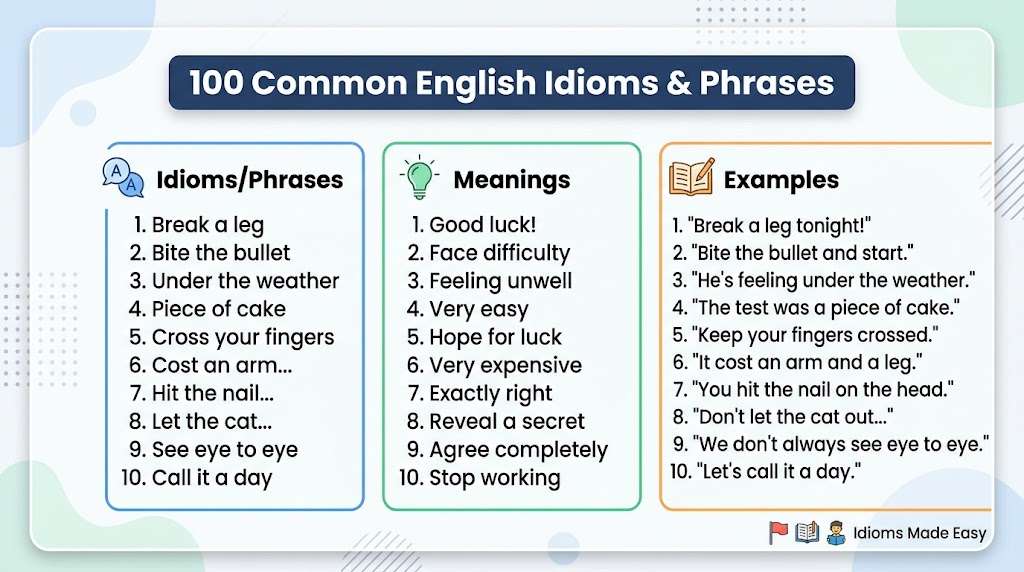
Have you ever felt like you understood every single word in an English sentence, yet the complete sentence made absolutely no sense?
Imagine a colleague telling you, “Let’s call it a day and hit the sack,” or a friend warning you not to “spill the beans.” If you take these expressions literally, you might imagine someone physically striking a sack or accidentally knocking over a bowl of leguminous seeds!
In reality, these expressions are idioms—figurative phrases whose meanings cannot be deduced simply by looking at the literal definitions of their individual words.
Idioms form the colorful backbone of the English language. According to linguistic studies, native English speakers use an average of three idioms every minute of conversation. Learning these expressions is the bridge between textbook English and real-world fluency.
In this exhaustive guide, we break down 100 of the most common English idioms and phrases, complete with straightforward definitions and practical example sentences organized by daily context.
Why Master English Idioms?
Before diving into the list, it is essential to understand why idioms matter so much in modern communication:
-
Enhance Natural Sounding Speech: Using idioms correctly immediately makes your spoken and written English sound more fluid and less robotic.
-
Improve Listening Comprehension: Recognizing idiomatic expressions prevents confusion when consuming English media, movies, podcasts, and workplace conversations.
-
Cultural Connection: Idioms reflect historical contexts, cultural humor, and shared values inherent to English-speaking countries.
-
Boost Exam Scores: Demonstrating a rich repertoire of idiomatic vocabulary is a key scoring criterion in English proficiency tests like IELTS, TOEFL, and Cambridge exams.
Key Takeaway: Do not memorize idioms by translating them word-for-word into your native language. Instead, learn them as complete units of meaning within specific contexts.
Category 1: Everyday & Daily Life Idioms (1–20)
These are the core workhorses of daily conversational English. You will hear them at home, on the street, and among friends.
1. A piece of cake
-
Meaning: Something that is extremely easy to do.
-
Example: Don’t worry about the driving test tomorrow; it’s going to be a piece of cake.
2. Bite the bullet
-
Meaning: To face a difficult situation with courage and get it over with.
-
Example: I hate going to the dentist, but I just need to bite the bullet and make an appointment.
3. Break a leg
-
Meaning: A way to wish someone good luck, especially before a performance.
-
Example: You have practiced your presentation for weeks. Go out there and break a leg!
4. Call it a day
-
Meaning: To stop working on something for the remainder of the day.
-
Example: We’ve been reviewing these figures for eight hours. Let’s call it a day.
5. Cutting corners
-
Meaning: Doing something poorly or cheaply to save time or money.
-
Example: The contractor cut corners on the construction, and now the roof is leaking.
6. Hit the sack / Hit the hay
-
Meaning: To go to bed or go to sleep.
-
Example: I have an early flight tomorrow, so I’m going to hit the sack early.
7. Under the weather
-
Meaning: Feeling slightly sick, ill, or unwell.
-
Example: Sarah won’t be joining us for lunch today because she’s feeling a bit under the weather.
8. Spill the beans
-
Meaning: To reveal a secret, usually by accident.
-
Example: We were planning a surprise party for Marcus, but his brother spilled the beans.
9. Pull someone’s leg
-
Meaning: To joke with or tease someone by telling them something untrue.
-
Example: Are you seriously moving to Alaska, or are you just pulling my leg?
10. Through thick and thin
-
Meaning: To support someone through good times and difficult times.
-
Example: Best friends stay by your side through thick and thin.
11. Once in a blue moon
-
Meaning: Something that happens very rarely.
-
Example: My brother lives abroad, so I only get to see him once in a blue moon.
12. Let the cat out of the bag
-
Meaning: To intentionally or accidentally disclose a secret.
-
Example: The company let the cat out of the bag about their new flagship phone ahead of schedule.
13. Burn the midnight oil
-
Meaning: To work or study late into the night.
-
Example: Final exam week is coming, so students are burning the midnight oil in the library.
14. Add insult to injury
-
Meaning: To make a bad situation even worse.
-
Example: First, my car broke down, and to add insult to injury, it started pouring rain while I waited for help.
15. Costs an arm and a leg
-
Meaning: Something that is very expensive.
-
Example: Buying a brand-new sports car will cost you an arm and a leg.
16. Jump on the bandwagon
-
Meaning: To join a popular trend or activity just because everyone else is doing it.
-
Example: Many companies are jumping on the AI bandwagon to attract investors.
17. Miss the boat
-
Meaning: To miss an opportunity by acting too slowly.
-
Example: If you don’t apply for the scholarship today, you’ll miss the boat.
18. On the fence
-
Meaning: Undecided about a choice or opinion.
-
Example: I’m still on the fence about whether to take the new job offer or stay at my current company.
19. See eye to eye
-
Meaning: To agree completely with someone.
-
Example: My business partner and I don’t always see eye to eye on marketing strategies.
20. Best of both worlds
-
Meaning: An ideal situation where you enjoy the advantages of two distinct opportunities simultaneously.
-
Example: Working remotely gives her the best of both worlds: a great career and time with her family.
Category 2: Business & Professional Idioms (21–40)
In corporate environments, professionals use idioms to communicate complex ideas quickly, soften criticism, or frame business decisions.
       +-------------------------------------------------+
       |           BUSINESS IDIOMS MATRIX                |
       +-------------------------------------------------+
       |  Planning & Strategy  |  Back to square one     |
       |                       |  Touch base             |
       +-----------------------+-------------------------+
       |  Action & Risk        |  Ball is in your court  |
       |                       |  Get down to brass tacks|
       +-----------------------+-------------------------+
       |  Conflict & Problems  |  Elephant in the room   |
       |                       |  Steal someone's thunder|
       +-------------------------------------------------+
21. Back to square one
-
Meaning: Having to start all over again because a previous attempt failed.
-
Example: The client rejected our initial design proposal, so it’s back to square one.
22. Ball is in your court
-
Meaning: It is now your responsibility to take the next step or make a decision.
-
Example: We have submitted our final price quotation; now the ball is in the client’s court.
23. Barking up the wrong tree
-
Meaning: Pursuing a mistaken line of thought or accusing the wrong person.
-
Example: If you think I took your documents, you’re barking up the wrong tree.
24. Beat around the bush
-
Meaning: Avoid talking about the main topic directly, usually because it is uncomfortable.
-
Example: Stop beating around the bush and just tell me what the new budget limit is.
25. By the book
-
Meaning: Following rules, regulations, or procedures strictly.
-
Example: The auditor checked every transaction by the book to ensure absolute compliance.
26. Get down to brass tacks
-
Meaning: To start focusing on the most important, basic facts of a situation.
-
Example: Let’s skip the small talk and get down to brass tacks regarding the budget.
27. Elephant in the room
-
Meaning: An obvious major problem or controversial topic that everyone avoids discussing.
-
Example: Nobody wanted to address the imminent layoffs, even though it was the elephant in the room.
28. Go the extra mile
-
Meaning: To put in more effort than expected or required.
-
Example: Our support team always goes the extra mile to ensure customer satisfaction.
29. Hit the nail on the head
-
Meaning: To describe or identify a problem or situation exactly right.
-
Example: You hit the nail on the head when you said our marketing campaign lacked clear targeting.
30. In the loop
-
Meaning: Kept informed about a project, topic, or situation.
-
Example: Please copy me on all email threads so I remain in the loop.
31. Keep your chin up
-
Meaning: To remain optimistic during difficult times.
-
Example: Keep your chin up; losing one client doesn’t mean your business is failing.
32. Learn the ropes
-
Meaning: To learn the basics or mechanics of how to perform a job or task.
-
Example: It takes a few weeks for new employees to learn the ropes around the office.
33. Off the cuff
-
Meaning: Spoken or done without preparation or rehearsal; spontaneous.
-
Example: He gave a brilliant speech off the cuff despite having no advance notice.
34. On the same page
-
Meaning: Sharing the same understanding, agreement, or perspective.
-
Example: Before we sign the contract, let’s make sure everyone is on the same page.
35. Play advocate / Devil’s advocate
-
Meaning: To argue an opposing point of view for the sake of thorough discussion.
-
Example: Allow me to play devil’s advocate: what happens if our supplier fails to deliver on time?
36. Raise the bar
-
Meaning: To elevate standards or expectations.
-
Example: The latest smartphone release has raised the bar for mobile display quality.
37. Steal someone’s thunder
-
Meaning: To take credit for someone else’s ideas or divert attention away from their achievements.
-
Example: She stole my thunder by announcing my project results before I could present them.
38. Think outside the box
-
Meaning: To think creatively from a novel, non-traditional perspective.
-
Example: To solve this complex logistics issue, we need to think outside the box.
39. Touch base
-
Meaning: To contact or briefly connect with someone to exchange information.
-
Example: Let’s touch base next Monday to review the project milestones.
40. Up in the air
-
Meaning: Unresolved, uncertain, or pending a final decision.
-
Example: Our travel plans for the upcoming quarter are still up in the air.
Category 3: Emotion & Mood Idioms (41–60)
These expressions help articulate feelings of joy, anxiety, anger, or relief with vivid detail.
41. Over the moon
-
Meaning: Extremely happy and delighted.
-
Example: She was over the moon when she found out she got accepted into medical school.
42. Down in the dumps
-
Meaning: Feeling sad, depressed, or discouraged.
-
Example: He’s been down in the dumps ever since his team lost the championship match.
43. On cloud nine
-
Meaning: A state of extreme happiness or bliss.
-
Example: After winning the award, he felt like he was on cloud nine all weekend.
44. Drive someone up the wall
-
Meaning: To annoy, irritate, or frustrate someone intensely.
-
Example: The persistent drilling noise from the construction site is driving me up the wall.
45. At the end of one’s tether / rope
-
Meaning: Having no patience, energy, or resilience left to cope with a problem.
-
Example: After dealing with broken software all day, I am at the end of my tether.
46. Bent out of shape
-
Meaning: Becoming overly angry, upset, or offended by something minor.
-
Example: Don’t get bent out of shape just because he forgot to return your pen.
47. Hot under the collar
-
Meaning: Angry, embarrassed, or agitated.
-
Example: The manager got hot under the collar when he saw the missed deadline.
48. In high spirits
-
Meaning: Cheerful, energetic, and lively.
-
Example: The team was in high spirits after closing their largest deal of the year.
49. Keep one’s cool
-
Meaning: To remain calm and composed in a stressful situation.
-
Example: Even when the customer started yelling, the representative managed to keep her cool.
50. Make someone’s blood boil
-
Meaning: To cause someone to feel extremely angry.
-
Example: Seeing people litter in public parks makes my blood boil.
51. No love lost
-
Meaning: Mutual dislike between two people or groups.
-
Example: There is no love lost between the two competing software manufacturers.
52. On pins and needles
-
Meaning: Anxiously or nervously waiting for news or an outcome.
-
Example: We were on pins and needles all afternoon waiting for the exam results.
53. Spill your heart out
-
Meaning: To share your deepest feelings and emotions candidly.
-
Example: She spilled her heart out to her sister about her relationship troubles.
54. Walk on eggshells
-
Meaning: To be extremely cautious in speech or action to avoid upsetting someone.
-
Example: Everyone in the department is walking on eggshells around the boss today.
55. Weight off one’s shoulders
-
Meaning: A feeling of immense relief after a problem or burden is removed.
-
Example: Passing that final accounting exam was a huge weight off my shoulders.
56. Beside oneself
-
Meaning: Overcome by intense emotion such as grief, anger, or worry.
-
Example: She was beside herself with concern when her dog went missing.
57. Green with envy
-
Meaning: Extremely jealous or envious of someone else.
-
Example: He was green with envy when his neighbor bought a brand-new yacht.
58. Have butterflies in one’s stomach
-
Meaning: Feeling nervous or anxious before performing or speaking in public.
-
Example: I always get butterflies in my stomach right before I walk onto the stage.
59. Bite someone’s head off
-
Meaning: To respond with sudden, angry verbal aggression over a minor issue.
-
Example: I only asked a simple question; there was no need to bite my head off!
60. Fly off the handle
-
Meaning: To lose one’s temper suddenly and unpredictably.
-
Example: He tends to fly off the handle whenever things don’t go according to plan.
Category 4: Decision & Action Idioms (61–80)
Use these idioms when describing choices, strategies, problem-solving, and taking action.
| # | Idiom / Phrase | Core Meaning |
| 61 | Bite off more than you can chew | Take on a task too big to handle |
| 62 | Burn bridges | Destroy relationships or pathways permanently |
| 63 | Cross that bridge when you come to it | Deal with a future problem only when it arrives |
| 64 | Cut to the chase | Focus immediately on the essential issue |
| 65 | Face the music | Accept negative consequences of one’s actions |
| 66 | Get your act together | Organize yourself and improve performance |
| 67 | Hit the ground running | Start a new activity quickly and energetically |
| 68 | Jump the gun | Act prematurely before the proper time |
| 69 | Keep something at bay | Prevent something dangerous from coming close |
| 70 | Leave no stone unturned | Try every possible solution or search thoroughly |
| 71 | Look before you leap | Consider risks before making a commitment |
| 72 | On the spur of the moment | Done impulsively without planning |
| 73 | Play it by ear | Handle a situation spontaneously as it develops |
| 74 | Put all your eggs in one basket | Risk everything on a single plan or venture |
| 75 | Rock the boat | Disturb a stable or peaceful situation |
| 76 | Sit on the fence | Delay making a decision between choices |
| 77 | Take something with a grain of salt | View information with skepticism |
| 78 | Throw in the towel | Give up or admit defeat |
| 79 | Turn over a new leaf | Make a fresh start by changing behavior |
| 80 | Weather the storm | Survive a difficult period or crisis |
Examples in Context:
-
Bite off more than you can chew: By agreeing to lead three major accounts simultaneously, David bit off more than he could chew.
-
Burn bridges: Never insult your former employer when resigning; it is never wise to burn bridges.
-
Cross that bridge when you come to it: We don’t know if rain will ruin the event, so let’s cross that bridge when we come to it.
-
Throw in the towel: After months of unsuccessful negotiations, the investors decided to throw in the towel.
Category 5: Time, Money & Miscellaneous Idioms (81–100)
These popular expressions deal with financial situations, time management, and general life observations.
81. In the nick of time
-
Meaning: Just in time; at the very last possible moment.
-
Example: The ambulance arrived in the nick of time to save the patient.
82. Around the clock
-
Meaning: Continuously without stopping for 24 hours.
-
Example: Emergency crews worked around the clock to restore electrical power to the city.
83. Ahead of the curve
-
Meaning: More advanced or innovative than competitors.
-
Example: By investing early in renewable technology, the company stayed ahead of the curve.
84. Time flies
-
Meaning: Time passes surprisingly quickly.
-
Example: Time flies when you are having fun with good friends.
85. Break the bank
-
Meaning: To cost more money than one can afford.
-
Example: Taking a weekend road trip doesn’t have to break the bank.
86. Money doesn’t grow on trees
-
Meaning: Financial resources are limited and require hard work to acquire.
-
Example: Put those expensive shoes back on the shelf; money doesn’t grow on trees!
87. Penny for your thoughts
-
Meaning: A way of asking someone what they are thinking about.
-
Example: You’ve been staring out the window quietly for ten minutes—a penny for your thoughts?
88. Pour money down the drain
-
Meaning: To waste money carelessly on useless things.
-
Example: Buying unused gym memberships is simply pouring money down the drain.
89. Born with a silver spoon in one’s mouth
-
Meaning: Born into a wealthy and privileged family.
-
Example: He has never had to worry about rent because he was born with a silver spoon in his mouth.
90. Live hand to mouth
-
Meaning: Having barely enough money to satisfy basic needs like food and shelter.
-
Example: Before securing a stable job, he spent years living hand to mouth.
91. A dime a dozen
-
Meaning: Very common and of little special value.
-
Example: Basic mobile wallpaper apps are a dime a dozen on application stores.
92. Barking up the wrong tree
-
Meaning: Directing effort or inquiries toward the wrong target.
-
Example: If you’re asking me for legal advice, you’re barking up the wrong tree.
93. Blessing in disguise
-
Meaning: A good outcome that initially appeared to be a misfortune.
-
Example: Missing that flight was a blessing in disguise because I met my future co-founder on the next one.
94. Cry over spilled milk
-
Meaning: Wasting time worrying about past mistakes that cannot be undone.
-
Example: The deal fell through, but there is no use crying over spilled milk—let’s move on.
95. Curiosity killed the cat
-
Meaning: Being overly inquisitive can lead to trouble or unwanted consequences.
-
Example: Don’t go searching through private office files; remember that curiosity killed the cat.
96. Every cloud has a silver lining
-
Meaning: Every difficult or negative situation has a positive aspect to it.
-
Example: Losing my job was tough, but every cloud has a silver lining—it pushed me to launch my own business.
97. Hit the road
-
Meaning: To depart or begin a trip.
-
Example: It’s getting late, so we should probably hit the road before traffic gets heavy.
98. Kill two birds with one stone
-
Meaning: Solve two problems or accomplish two goals with a single action.
-
Example: By cycling to work, I get my daily workout and save on commuting costs, killing two birds with one stone.
99. Practice makes perfect
-
Meaning: Repeating a skill regularly leads to mastery.
-
Example: Don’t get discouraged if you make mistakes while speaking English—practice makes perfect.
100. Smooth sailing
-
Meaning: Easy progress without any difficulties, obstacles, or complications.
-
Example: Once we obtained the permits, the rest of the building project was smooth sailing.
3 Critical Mistakes to Avoid When Using Idioms
Using idioms can elevate your English, but using them incorrectly can cause awkward misunderstandings. Here are the top three pitfalls to avoid:
1. Literal Word Translation
Idioms lose their meaning when translated word-for-word into another language or from your native language into English.
Wrong: “I am feeling under the weather condition.”
Right: “I am feeling under the weather.”
2. Mixing Up Idiomatic Expressions (Malapropisms)
Combining two distinct idioms confuses listeners.
Wrong: “We’ll burn that bridge when we come to it.” (Blends burn bridges + cross that bridge when we come to it)
Right: “We’ll cross that bridge when we come to it.”
3. Overusing Idioms in Formal Writing
Idioms are predominantly informal or semi-formal. Avoid packing formal academic essays, legal contracts, or serious corporate press releases with heavy idiomatic expressions. Reserve them for speeches, conversational contexts, emails, and engaging articles.
Frequently Asked Questions (FAQ)
What is the difference between an idiom and a phrase?
A phrase is any group of words standing together as a conceptual unit (e.g., “in the morning”). An idiom is a specific type of phrase whose meaning is figurative and cannot be understood literally from the individual words themselves (e.g., “bite the bullet”).
How can non-native speakers memorize English idioms fast?
The most effective way to memorize idioms is through contextual learning. Group idioms by themes (like emotions, work, or daily life), study them within real-life context sentences, and practice using 2–3 new idioms each day in conversation or journal writing.
Are idioms used in formal English writing like IELTS or academic essays?
In general, idioms should be used sparingly in formal academic essays or technical reports. However, in tests like the IELTS Speaking Module, using idiomatic expressions appropriately is essential for demonstrating advanced lexical resource and achieving a Band 7 score or higher.
Conclusion: Start Using Idioms Today!
Mastering idioms is an essential step on your path toward native-level English fluency. By incorporating these 100 common English idioms into your everyday vocabulary, you will improve your listening comprehension, express complex feelings with precision, and communicate with clarity and flair.
What to do next: Pick 5 idioms from this guide right now that resonate with your daily life. Write down your own custom example sentences using them, and try using at least one of them in your very next English conversation or email!

Nasir is our resident expert with 5 years of experience in business development and marketing strategies. With a keen eye for market trends and a knack for creating impactful campaigns, Nasir helps drive our vision forward with innovative solutions and data-driven insights. His articles provide valuable perspectives on navigating the ever-evolving world of business.