
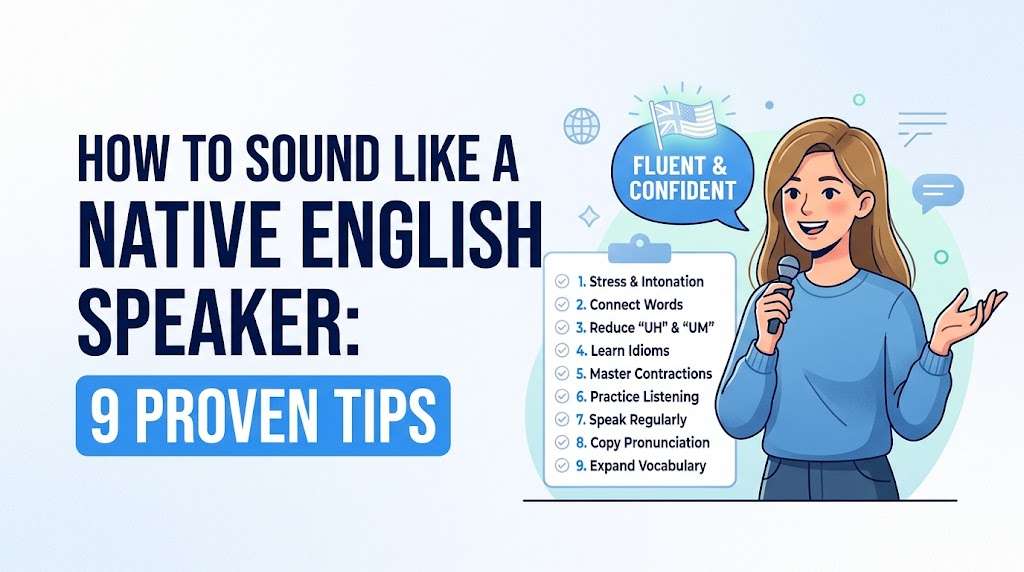
For millions of adult language learners worldwide, reaching conversational fluency in English is only half the battle. You might possess an extensive vocabulary, understand complex grammatical structures, and write flawlessly, yet still find yourself repeating phrases during everyday conversations, feeling self-conscious in professional meetings, or dealing with communication friction due to a heavy foreign accent.
The goal of sounding like a native English speaker is rarely about erasing your cultural identity or eliminating your heritage accent entirely. Instead, it is about developing intelligibility, rhythmic naturalness, and effortless phonetic precision.
This comprehensive guide breaks down the mechanics of native English pronunciation into actionable, science-backed steps. Whether you are aiming for General American (GA) or Received Pronunciation (RP), you will learn how native speakers link words, control intonation, master word stress, and train their vocal muscles for crystal-clear delivery.
The Hidden Architecture of Native Speech: Stress-Timed Rhythm
To understand why traditional language learning fails to teach authentic pronunciation, you must understand the fundamental difference between syllable-timed and stress-timed languages.
+-----------------------------------------------------------------------------------+
|                                 LANGUAGE RHYTHMS                                  |
+-----------------------------------------------------------------------------------+
| Syllable-Timed (Spanish, French, Japanese)                                       |
|  [ Syllable 1 ]  [ Syllable 2 ]  [ Syllable 3 ]  [ Syllable 4 ]  (Equal Duration) |
+-----------------------------------------------------------------------------------+
| Stress-Timed (English, German, Dutch)                                             |
|  [ STRESSED ] . . . [ STRESSED ] . . . . . . [ STRESSED ]       (Equal Intervals)|
+-----------------------------------------------------------------------------------+
Languages like Spanish, French, Italian, and Japanese are syllable-timed. Every syllable receives roughly the same duration and equal vocal effort.
English, on the other hand, is a stress-timed language. Stressed syllables occur at regular time intervals, while unstressed syllables are squished, reduced, or shortened to fit the beat.
Key Takeaway: Native English speakers do not pronounce every word with equal weight. They speak in a rhythmic cadence where content words carry energy and function words are compressed.
1. Content Words vs. Structure Words
Native speech relies on a constant balance between stressed content words and unstressed structure words.
-
Content Words (Stressed): Nouns, main verbs, adjectives, and adverbs. These carry the core meaning of the sentence.
-
Examples: CATS, CHASE, MICE, QUICKLY.
-
-
Structure Words (Unstressed): Prepositions, articles, pronouns, conjunctions, and auxiliary verbs. These hold the sentence together grammatically.
-
Examples: the, of, for, and, is, was, has, can.
-
2. The Power of sentence-level Rhythm
Consider this classic example illustrating stress-timing in action. Notice how the overall duration of the sentence remains relatively constant because the number of stressed beats remains four across all variations:
-
CATS CHASE MICE QUICKLY. (4 syllables, 4 beats)
-
The CATS will CHASE the MICE QUICKLY. (7 syllables, 4 beats)
-
The CATS will have CHASED all the MICE very QUICKLY. (10 syllables, 4 beats)
Pro Tip: Tap your foot on the bolded, capital words. Do not slow down your tapping as more words are added in lines 2 and 3; instead, squeeze the unbolded words into the space between taps.
Step 1: Master the Vowel Spectrum & The Neutral Schwa Sound
If English pronunciation had a single secret weapon, it would be the Schwa sound (/\partial/\text{/\partial/}).
The schwa is the most common vowel sound in the English language. It is a neutral, relaxed, unaccented vowel created by relaxing your mouth completely, keeping your tongue in the center, and making a short, gentle vocal impulse.
      Schwa Phonetic Position
           [ Unstressed ]
              / \
             /   \
  Relaxed Jaw --- Neutral Tongue
The Mechanism of Vowel Reduction
Non-native speakers often make the mistake of pronouncing written vowels literally. In native English, almost any unaccented vowel written as A, E, I, O, or U collapses into a schwa.
Pro Tip: Look closely at Photograph versus Photography. When the primary stress shifts from the first syllable to the second, the vowel sound shifts from a full vowel sound to a compressed schwa sound!
Fixing Short vs. Long Vowel Pairs
Many non-native speakers struggle with subtle vowel distinctions. Pay special attention to these three high-frequency contrast pairs:
1. The /ɪ/ (Short I) vs. /iː/ (Long EE)
-
Sit (/sɪt/) vs. Seat (/siːt/)
-
Bit (/bɪt/) vs. Beet (/biːt/)
-
Correction: For /ɪ/ (sit), keep your jaw relaxed and tongue lax. For /iː/ (seat), smile slightly and pull your tongue high and forward toward your hard palate.
2. The /ʊ/ (Short U) vs. /uː/ (Long OO)
-
Full (/fʊl/) vs. Fool (/fuːl/)
-
Look (/lʊk/) vs. Luke (/luːk/)
-
Correction: The short /ʊ/ requires loose lips and a neutral jaw. The long /uː/ requires tight, rounded, pouted lips.
Step 2: Mechanics of Connected Speech (Linking & Reductions)
Native English speakers rarely pronounce words as isolated units. Instead, they stream words together in continuous breath groups. This process is called connected speech.
If you pronounce every word as a separate, isolated block, your speech will sound robotic, staccato, and foreign.
Isolated Speech:   [ I ] + [ Want ] + [ To ] + [ Go ] + [ To ] + [ The ] + [ Park ]
Connected Speech:  [ Iwan-n$\partial$-go-t$\partial$-th$\partial$-park ]
1. Consonant-to-Vowel Linking
When a word ends in a consonant sound and the next word starts with a vowel sound, smooth the final consonant over into the beginning of the next word.
-
Written: Check it out.
-
Native Stream: Che-ki-tout (/tʃɛ kɪ taʊt/)
-
Written: An apple on an arm.
-
Native Stream: A-na-pple-o-na-narm.
2. Vowel-to-Vowel Linking (Intrusive /w/ and /j/)
When one word ends in a vowel and the next word begins with a vowel, native speakers naturally insert a subtle glided consonant sound (/w/ or /j/) to keep the vocal stream moving without abrupt pauses.
-
Inserting /y/ (/j/): Occurs after front vowels (/eɪ/, /iː/, /aɪ/, /ɔɪ/).
-
Written: I agree →\rightarrow Pronounced: I-y-agree
-
Written: They are →\rightarrow Pronounced: They-y-are
-
-
Inserting /w/: Occurs after rounded back vowels (/uː/, /oʊ/, /aʊ/).
-
Written: Go away →\rightarrow Pronounced: Go-w-away
-
Written: Do it →\rightarrow Pronounced: Do-w-it
-
3. Assimilation and Elision
Native speech regularly drops sounds (elision) or merges sounds together (assimilation) to achieve maximum oral efficiency.
Assimilation Examples:
-
T + Y = CH (/tʃ/): “Don’t you” becomes “Don-choo”
-
D + Y = J (/dʒ/): “Would you” becomes “Wood-joo”
Elision Examples (Dropping Unstressed Sounds):
-
Next door becomes “Nex-door” (The /t/ sound drops out).
-
Stand there becomes “Stan-there” (The /d/ sound drops out).
Step 3: Mastering Difficult Consonant Articulations
Consonants provide structure to your words. Mispronouncing them forces the listener to expend mental energy decoding your speech rather than listening to your message.
1. The Dental Fricatives: Hard vs. Soft “TH”
The “TH” sound does not exist in most languages, leading many non-native speakers to replace it with /s/, /z/, /t/, or /d/.
  PLACEMENT FOR "TH" (/θ/ and /ð/)

        Upper Teeth
      [  |  |  |  |  ]
      ================  <-- Touch tip of tongue gently to upper teeth
        [ Tongue ]
-
Voiceless “TH” (/θ/): Air pushes past tongue without vocal cord vibration.
-
Practice: Think, Thank, Thirty, Bath, Math.
-
Avoid: Pronouncing “Think” as “Sink” or “Tink”.
-
-
Voiced “TH” (/ð/): Vocal cords vibrate while air pushes past tongue.
-
Practice: This, That, These, Those, Mother, Breathe.
-
Avoid: Pronouncing “This” as “Zis” or “Dis”.
-
2. The American Flap /t/ Sound
In General American English, when a /t/ sound falls between two vowel sounds and is not at the start of a stressed syllable, it turns into a Flap T (sounding very close to a quick, light /d/ or a rolled single-tap ‘R’).
-
Water →\rightarrow Pronounced as “Wah-der”
-
Better →\rightarrow Pronounced as “Beh-der”
-
Butter →\rightarrow Pronounced as “Buh-der”
-
Computer →\rightarrow Pronounced as “Com-pyoo-der”
Example Exercise: Say this sentence aloud using Flap Ts:
“I put a better bottle of water on the table.”
Phonetic target: “I poot-a beh-der bah-der’ve wah-der on-da tay-bul.”
3. De-Voicing Final Consonants
A major marker of a non-native accent is turning voiced final consonants into voiceless ones.
VOICED ENDINGS          VOICELESS ENDINGS
(Vocal Cords Vibrate)    (Air Only)
-------------------      -----------------
  Dog (/g/)                Dock (/k/)
  Buzz (/z/)               Bus (/s/)
  Mad (/d/)                Mat (/t/)
  Cab (/b/)                Cap (/p/)
The Rule of Vowel Length: Vowels preceding a voiced final consonant are stretched out slightly longer than vowels preceding a voiceless consonant.
-
The word “Bag” has a noticeably longer vowel sound than the word “Back”.
Step 4: Intonation Patterns & Vocal Melody
Intonation is the musical melody of speech. Using incorrect intonation can send confusing emotional signals—making you sound rude, bored, unsure, or overly aggressive even when your word choice is perfectly polite.
        INTONATION TRAJECTORIES

  Falling:      \   (Statements, Commands, Wh- Questions)
                 \
  Rising:        /  (Yes/No Questions, Uncertainty)
                /
  Non-Final:  ---\_ (Continuing a list or thought)
1. Falling Intonation (↘\searrow)
Falling intonation moves from a high pitch down to a low pitch on the final stressed syllable. It signals certainty, completion, authority, and finality.
-
Statements: “I live in New York.” (↘\searrow)
-
Wh- Questions: “Where is the meeting?” (↘\searrow)
-
Commands: “Please sit down.” (↘\searrow)
2. Rising Intonation (↗\nearrow)
Rising intonation moves from a lower pitch up to a higher pitch at the end of a clause. It signals doubt, open-endedness, or a request for confirmation.
-
Yes/No Questions: “Are you coming to the party?” (↗\nearrow)
-
Clarification Requests: “Pardon me?” (↗\nearrow)
3. Non-Final Intonation (Pitch Waves)
When delivering a list or splitting a complex sentence across multiple clauses, native speakers keep their pitch slightly elevated on non-final items to tell the listener that more information is coming.
Example:
“I need to buy apples (↗\nearrow), bananas (↗\nearrow), oranges (↗\nearrow), and milk (↘\searrow).”
Notice how the pitch rises on every item in the list and drops only on the final item (“milk”) to signal that the list is complete.
Step 5: Advanced Exercises to Build Native Muscle Memory
Pronunciation is not a cognitive knowledge problem; it is a physical muscle memory challenge. Your tongue, lips, vocal cords, and jaw have used specific patterns for decades. Rewiring them requires deliberate physical conditioning.
+----------------------------------------------------------------------------------+
|                            THE 4-STEP SHADOWING CYCLE                            |
+----------------------------------------------------------------------------------+
|  [Step 1: Active Listen]  --> Listen to audio 3x without speaking.               |
|                                                                                  |
|  [Step 2: Script Analysis] --> Mark stresses (*), pauses (|), and links (_).     |
|                                                                                  |
|  [Step 3: Simultaneous Shadow] --> Speak out loud alongside audio with 0s delay. |
|                                                                                  |
|  [Step 4: Record & Contrast]  --> Record yourself and compare waveform/audio.    |
+----------------------------------------------------------------------------------+
1. The Shadowing Technique
Shadowing is an audio-playback technique where you listen to a native speaker and repeat what they are saying simultaneously with less than a second of delay.
How to Execute a Shadowing Practice Session:
-
Source Material: Select a 60-second clip of a native speaker whose accent you want to emulate (e.g., a podcast host, TED Talk speaker, or news anchor).
-
Phase 1 (Active Listening): Listen to the clip three times. Focus entirely on where the speaker pauses, raises their pitch, and links words together.
-
Phase 2 (Script Annotation): Print or write out the transcript. Use a pen to mark:
-
Underlines for linked words (check_it_out)
-
Strikethroughs for dropped sounds (nex[t] door)
-
Bolds for stressed content words
-
Slashes (/) for pauses and breath groups
-
-
Phase 3 (Simultaneous Delivery): Play the clip and speak aloud alongside the recording. Match their pitch, pacing, pauses, and accent instantly.
-
Phase 4 (Recording and Self-Audit): Record your own voice performing the script without the reference track playing. Listen back side-by-side with the original recording to spot discrepancies.
2. Vocal Tract Physical Exercises
Native English requires different tongue positions and lower jaw tension compared to languages like French, Russian, or Mandarin.
-
Jaw De-Tensioning: Open your mouth wide and gently masseter-massage your jaw joints. English requires a low, relaxed jaw for open vowels like /æ/ (cat) and /ɑː/ (father).
-
Tongue Tip Strengthening: Practice tapping the tip of your tongue against your alveolar ridge (the hard ridge right behind your top front teeth) in rapid succession: t-d-t-d-t-d. This trains the agility needed for fast flap /t/ and linked consonant sounds.
Common Pitfalls & Accent Mistakes to Avoid
Even advanced speakers drop into subtle accent traps that give away non-native patterns instantly. Here is how to fix the top four mistakes:
+-----------------------------------------------------------------------------------+
|                            4 COMMON ACCENT PITFALLS                               |
+-----------------------------------------------------------------------------------+
| ❌ Over-Enunciating Every Syllable  --> Fix: Embrace the Schwa & compress words.   |
| ❌ Ignoring Word Stress Shifting   --> Fix: Learn how stress changes word class.   |
| ❌ Misplacing Primary Pitch Accent  --> Fix: Stress the NEW info in a sentence.   |
| ❌ Reading English Phonetically    --> Fix: Trust your ears, not spelling rules.  |
+-----------------------------------------------------------------------------------+
1. Over-Enunciating Unstressed Words
-
The Error: Speaking every word clearly and distinctly (e.g., saying “I want TO go TO THE store”).
-
The Fix: Compress function words. Say: “I want-∂\partial-go-t-∂\partial-th-∂\partial store.”
2. Ignoring Word-Stress Shifts in Noun/Verb Pairs
-
The Error: Pronouncing nouns and verbs with identical stress patterns.
-
The Fix: Many English words switch their stressed syllable depending on whether they act as a noun or a verb.
3. Misplacing Primary Sentence Stress (Tonic Stress)
-
The Error: Putting the loudest stress on the wrong word, which alters the sentence’s implied meaning.
-
The Fix: Move the primary sentence stress to highlight the specific information you want to emphasize:
I didn’t say she stole the money. (Someone else said it.)
I DIDN’T say she stole the money. (I strongly deny saying it.)
I didn’t SAY she stole the money. (I implied it, but didn’t state it out loud.)
I didn’t say SHE stole the money. (I think someone else stole it.)
I didn’t say she stole THE MONEY. (She stole something else.)
Daily 15-Minute Practice Routine for Natural Speech
Consistency beats intensity when training motor neural pathways. Follow this daily 15-minute training block to build native English speech habits over time:
+-----------------------------------------------------------------------------------+
|                           DAILY 15-MINUTE ACCENT ROUTINE                          |
+-----------------------------------------------------------------------------------+
|  [00:00 - 03:00]  Warm-Up: Vocalization, Jaw Release, & Tongue Taps             |
|  [03:00 - 07:00]  Phoneme Target Practice (Focus on single sound pairs)           |
|  [07:00 - 12:00]  Shadowing Practice (60-second audio clip with annotations)       |
|  [12:00 - 15:00]  Self-Recording & Feedback Comparison                            |
+-----------------------------------------------------------------------------------+
-
Minutes 0–3: Warm-Up
Relax your jaw, hum at a low pitch, and perform quick tongue taps behind your teeth to wake up your vocal tract.
-
Minutes 3–7: Phoneme Focus
Select one challenging contrast pair for the day (e.g., /v/ vs /w/, /θ/ vs /t/, or /ɪ/ vs /iː/). Practice minimal pairs in front of a mirror to ensure your mouth shape is accurate.
-
Minutes 7–12: Active Shadowing
Take a 60-second audio clip from native media. Shadow the speaker, mirroring their rhythm, word-linking, and intonation curve.
-
Minutes 12–15: Record & Compare
Record yourself reading the same passage without the reference audio. Play it back side-by-side with the native sample and make note of one specific area to improve tomorrow.
Frequently Asked Questions
1. Is it necessary to eliminate my foreign accent completely to sound fluent?
No. Accent elimination should not be your target; clarity, rhythm, and high intelligibility should be. Native listeners have no trouble understanding speakers with regional or foreign accents as long as word stress, intonation patterns, and core consonant contrast pairs are clear.
2. What is the fastest way to stop sounding robotic when speaking English?
Focus on connected speech and vowel reduction. Stop treating every word as an isolated unit. Practice dropping unaccented vowels down to the relaxed schwa (/\partial/\text{/\partial/}) sound and glide final consonants directly into the starting vowels of subsequent words.
3. Should I learn American English or British English pronunciation?
Select the dialect aligned with your personal, academic, or professional environment. General American (GA) and Received Pronunciation (RP) share the exact same underlying rules for stress-timed sentence rhythms and word linking. Pick one target dialect so your vowel patterns remain consistent.
4. Why can I pronounce words correctly individually, but lose my accent training during live conversations?
When speaking live, your brain prioritizes real-time word retrieval and grammar construction over mechanical mouth movement. This is completely normal. Combat this by building muscle memory through daily shadowing exercises so correct mouth positions become automatic over time.
Conclusion: Transform Your Pronunciation Today
Sounding like a native English speaker is not an innate gift—it is a physical skill built on specific vocal mechanics, stress-timed rhythms, and consistent auditory training.
By mastering the schwa sound, leaning into connected speech, controlling sentence intonation, and committing to daily shadowing exercises, you can transform your spoken English from clear to truly effortless.
Your Next Action Step
Do not try to implement every technique in this guide at once. Choose one specific area to work on this week—whether that is softening your flap /t/ sounds, catching unaccented vowels to use the schwa, or running a daily 5-minute shadowing drill. Practice it until it becomes second nature, and build your confidence from there.

Nasir is our resident expert with 5 years of experience in business development and marketing strategies. With a keen eye for market trends and a knack for creating impactful campaigns, Nasir helps drive our vision forward with innovative solutions and data-driven insights. His articles provide valuable perspectives on navigating the ever-evolving world of business.