
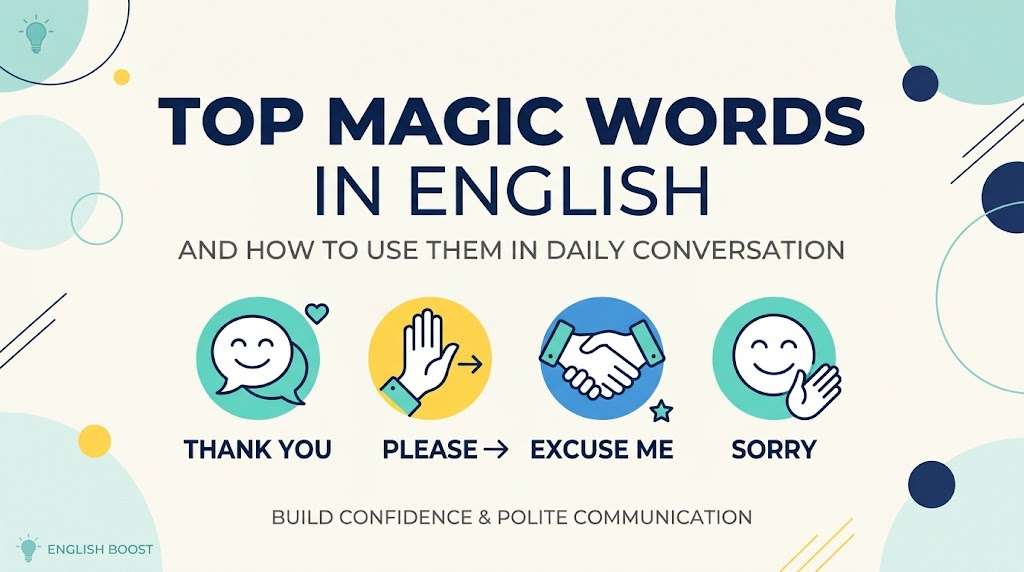
Words possess extraordinary power. In daily human interaction, certain polite expressions act as social lubricants—softening demands, building instant trust, resolving misunderstandings, and opening doors that sheer force or logic could never budge. In English speech, these expressions are universally referred to as “magic words.”
Whether you are a non-native English learner working to refine your fluency or a native speaker striving to elevate your personal and professional interpersonal skills, mastering these essential words and phrases is transformative. This comprehensive guide details the foundational magic words in English, dissecting their psychological mechanics, precise contextual usage, real-world conversational applications, common mistakes to avoid, and practical strategies to build them seamlessly into your daily dialogue.
The Psychology of Politeness: Why Magic Words Work
Before exploring the individual vocabulary terms, it is crucial to understand why magic words carry such immense psychological leverage. Politeness is not merely an arbitrary set of rules designed for polite society; it is a sophisticated system of verbal cues that Signal respect, safety, and mutual recognition.
[Social Signal: Respect & Deference]
                │
                ▼
  [Reduces Social Friction & Defensiveness]
                │
                ▼
  [Increases Cooperation & Trust]
1. Politeness Theory and Positive vs. Negative Face
In sociolinguistics, Penelope Brown and Stephen C. Levinson developed Politeness Theory, which suggests that every individual possesses a self-image called “face.”
-
Positive Face: The desire to be liked, appreciated, connected, and approved of.
-
Negative Face: The desire to maintain autonomy, freedom of action, and unhindered agency.
Magic words act as protective shields for both positive and negative face. When you prepend a request with “Please,” you acknowledge that you are potentially encroaching on the other person’s time or freedom (protecting their negative face). When you say “Thank you,” you validate their worth, effort, and generosity (nourishing their positive face).
2. De-Escalation and Defense Reduction
Human brains are wired to detect threats in communication. Demanding statements such as “Give me that file” activate a defensive psychological response. Inserting magic words signals safety, lowering social friction instantly.
Key Takeaway: Magic words act as verbal safety signals. They acknowledge the recipient’s dignity and sovereignty, lowering defensive barriers and creating an environment ripe for collaboration.
The 6 Essential Magic Words in English
While there are dozens of polite variations, six fundamental words and phrases form the bedrock of etiquette in English communication.
| Magic Word / Phrase | Primary Function | Ideal Context | Primary Psychological Benefit |
| Please | Polishing requests | Asking for assistance, ordering, requesting information | Respects recipient autonomy |
| Thank You | Expressing gratitude | Receiving help, gifts, compliments, or services | Validates recipient effort |
| Excuse Me | Navigating physical & verbal space | Interrupting, moving past someone, seeking attention | Minimizes intrusion |
| I’m Sorry / Apologies | Acknowledging errors & empathy | Expressing regret, ownership of mistakes, sympathy | Restores trust & safety |
| You’re Welcome | Receiving gratitude gracefully | Responding to “Thank you” | Reaffirms mutual goodwill |
| May I / Could You | Softening imperatives | Professional queries, permissions | Replaces demanding language |
1. “Please” — The Universal Key to Cooperation
“Please” is often the very first magic word taught to young children, and for good reason: it converts an imperative command into an inviting request.
Command (High Friction):   "Send me the report by 3 PM."
Request (Low Friction):   "Could you please send me the report by 3 PM?"
How to Use “Please” Effectively
-
Beginning of a sentence: Offers an immediate tone of deference (“Please let me know your thoughts.”).
-
Middle of a sentence: Integrates smoothly into modal verb phrases (“Could you please hand me that document?”).
-
End of a sentence: Adds a gentle emphasis to a request (“Can you assist me with this, please?”).
Pro Tip: Avoid overusing “please” in situations where direct authority or clear instruction is required without negotiation (e.g., critical safety instructions or urgent crisis interventions), as it can dilute clarity.
2. “Thank You” — The Gratitude Anchor
“Thank you” (and its informal counterpart, “Thanks”) acknowledges that someone has spent energy, time, or resources for your benefit.
Nuances of Gratitude in Daily Contexts
-
The Specific Gratitude Phrase:
-
Generic: “Thanks.”
-
High-Impact: “Thank you so much for taking the time to explain that detail—it really cleared up my confusion.”
-
-
Professional vs. Casual Forms:
-
Casual: “Thanks a bunch!”, “Thanks a ton!”, “Cheers!” (UK/Australia/NZ).
-
Professional: “Thank you for your prompt assistance,” “I truly appreciate your support.”
-
Level 1 (Basic):   "Thanks!"
Level 2 (Standard): "Thank you very much."
Level 3 (Impact):   "Thank you for your help with the presentation today—your input was invaluable!"
3. “Excuse Me” — Navigating Spaces and Interruptions
“Excuse Me” serves as a proactive polite buffer. It is used before an potential intrusion or minor disruption occurs.
Three Primary Contexts for “Excuse Me”
-
Physical Space: Passing through a crowded corridor or store aisle (“Excuse me, may I squeeze past?”).
-
Verbal Interruption: Politely gaining attention or interrupting a conversation (“Excuse me, do you have a quick moment?”).
-
Clarification: Asking someone to repeat what they said (“Excuse me? I didn’t quite catch that last sentence.”).
Distinction Note: Do not confuse “Excuse me” with “I’m sorry.” Use “Excuse me” proactively prior to an action or to gain attention; use “I’m sorry” reactively after an error or inconvenience has occurred.
4. “I’m Sorry” — Restoring Social Harmony
Apologizing is one of the most powerful forms of corrective communication. Saying “I’m sorry” or “My apologies” takes accountability, validates the other person’s feelings, and restores trust.
The Anatomy of an Effective Apology
A complete apology involves three distinct elements:
-
The Acknowledgment: Expressing regret (“I am so sorry for arriving late.”).
-
Ownership: Accepting responsibility without defensive rationalization (“I should have left earlier to account for traffic.”).
-
The Remedy: Offering a path forward (“Next time, I will buffer my travel time. Let’s get started right away.”).
Weak Apology:   "I'm sorry you feel that way, but traffic was terrible."
Strong Apology: "I'm sorry I kept you waiting. I takes responsibility for the delay, and I appreciate your patience."
5. “You’re Welcome” — Completing the Politeness Loop
Leaving a “Thank you” unacknowledged creates social awkwardness. Responding with “You’re welcome” closes the interaction with warmth and reciprocity.
Variations and Usage Matrix
-
Standard Professional: “You are very welcome.” / “It is my absolute pleasure.”
-
Casual/Friendly: “No problem at all!” / “Anytime!” / “Happy to help!”
-
Service/Hospitality: “My pleasure!” / “Glad to be of service!”
Pro Tip: In modern professional environments, replacing “No problem” with “Happy to help” or “You’re welcome” often sounds more respectful, as “No problem” can occasionally imply that the favor was a potential burden.
6. Modal Auxiliaries (“May I”, “Could You”, “Would You”)
While single words like “please” are essential, modal verbs form the structural magic that turns sharp statements into gracious inquiries.
Direct Command:   "Give me a glass of water."
Polite Modal:     "Could I please have a glass of water?"
Formal Permission: "May I trouble you for a glass of water?"
Quick Reference for Modal Softeners
-
Permission: Use “May I…” instead of “Can I…” in formal or respectful contexts.
-
Requesting Actions: Use “Could you…” or “Would you mind…” instead of “Will you…” or direct imperatives.
Real-World Conversational Scenarios
To see these magic words in action, let’s examine common daily scenarios across different settings.
Scenario A: Workplace Collaboration
-
Situation: You need a colleague to review a 10-page document before end-of-day.
Incorrect (Aggressive):
"Look over this document and give me feedback before 5 PM."

Correct (Polite & Effective):
"Hi Sarah, when you have a moment, could you please take a look at this draft?
I would really appreciate your feedback by 5 PM if your schedule allows.
Thank you so much!"
Scenario B: Ordering at a Coffee Shop or Restaurant
-
Situation: Ordering your morning coffee from a busy barista.
Incorrect (Abrupt):
"I want a large latted with almond milk."

Correct (Warm & Respectful):
"Good morning! May I please get a large latte with almond milk?
Thank you!"
Scenario C: Handling an Accidental Bump in Public
-
Situation: Accidentally stepping on someone’s foot on public transportation.
Incorrect (Indifferent):
[Silence or brief glance away]

Correct (Attentive):
"Oh, I'm so sorry! I didn't see your foot there. Are you alright?"
Common Pitfalls and Mistakes to Avoid
Even well-intentioned speakers can misuse magic words. Avoid these common traps to ensure your communication remains sincere and effective.
                    PITFALLS TO AVOID
                           │
       ┌───────────────────┼───────────────────┐
       ▼                   ▼                   ▼
Passive-Aggressive    Over-Apologizing     Insincere/Robot
  Tones ("Per my")      ("Sorry to exist")   Rote Recitation
1. Passive-Aggressive Magic Words
Adding “please” or “thank you” to a harsh sentence does not make it polite; it often makes it sarcastic or aggressive.
-
Example: “Please try to actually read my email this time, thanks.”
-
Fix: Keep the tone genuine and objective: “Could you please re-check the attached document? Let me know if you have any questions.”
2. Over-Apologizing (“Sorry Syndrome”)
Using “I’m sorry” as a filler phrase for basic existence undermines confidence and authority.
-
Incorrect: “I’m sorry, but can I ask a quick question?”
-
Fix: Replace unnecessary apologies with direct politeness: “Excuse me, may I ask a quick question?” or “Thank you for your time—do you have a quick minute?”
3. Insincere Rote Recitation
Saying magic words in a flat, monotone, or rushed voice strips them of their emotional power. Body language, facial expression, and vocal inflection must match the meaning of the words.
Frequently Asked Questions (FAQ)
What are the main magic words in English?
The primary magic words in English are Please, Thank You, Excuse Me, I’m Sorry, and You’re Welcome. Additionally, polite phrases using modal verbs like “May I” and “Could you” serve the same function.
Is saying “No problem” considered rude?
No, “No problem” is widely accepted in casual, everyday English, especially among younger speakers. However, in formal business contexts or high-end service industries, traditional responses like “You’re welcome” or “It’s my pleasure” are preferred.
How can non-native English speakers practice using magic words naturally?
The best approach is to shadow native audio, focus on warm vocal intonation, and integrate polite modal phrases (“Could you…”, “Would you…”) into daily interactions such as ordering food, writing emails, and greeting colleagues.
What is the difference between “Excuse me” and “Pardon me”?
Both express the same core intention. “Excuse me” is standard across North America and global English dialects, whereas “Pardon me” (or simply “Pardon?”) is slightly more formal, common in British English, or used specifically when asking someone to repeat themselves.
Conclusion & Call to Action
The “magic” in English magic words is not mystical—it is rooted in human psychology, empathy, and social conditioning. By thoughtfully incorporating Please, Thank You, Excuse Me, I’m Sorry, and You’re Welcome into your daily speech, you build stronger relationships, reduce unnecessary conflicts, and present yourself as a polished, respectful communicator.
Take Your English Skills to the Next Level
Start applying these magic words in your very next conversation today! Pay attention to the tone, timing, and warmth of your delivery, and notice how quickly people respond with increased cooperation and warmth.
Have a favorite polite expression or a real-world story where magic words saved the day? Share your thoughts in the comments below or subscribe to our language newsletter for weekly communication tips!

Nasir is our resident expert with 5 years of experience in business development and marketing strategies. With a keen eye for market trends and a knack for creating impactful campaigns, Nasir helps drive our vision forward with innovative solutions and data-driven insights. His articles provide valuable perspectives on navigating the ever-evolving world of business.