
Clear communication is the bedrock of professional authority, academic success, and personal credibility. Whether you are writing a critical client email, publishing an industry whitepaper, or crafting your next blog post, the grammar you use acts as your intellectual signature. Yet, even seasoned writers and native speakers frequently trip over subtler nuance rules, syntax traps, and homophones.
Grammatical errors do more than just violate arbitrary rules from high school textbooks; they create cognitive friction for your readers, obscuring your core message and eroding trust. A single misplaced modifier or a subtle subject-verb disagreement can instantly shift the tone of a message from authoritative to careless.
In this comprehensive guide, we will break down 15 of the most pervasive English grammar mistakes, explain the underlying linguistic mechanics behind each error, and provide simple, foolproof frameworks to help you eliminate them from your writing permanently.
The Cognitive Cost of Poor Grammar in Writing
Before diving into specific rules, it is vital to understand why grammatical accuracy matters beyond stylistic preferences. When someone reads your text, their brain naturally processes syntax to extract meaning.
When a sentence contains a structural flaw, the reader’s subconscious processing hits a barrier. This forces them to stop, re-read, and manually decipher your intent.
Key Takeaway: Correct grammar isn’t about perfectionism—it is about reducing friction for your reader so your ideas can shine through uninterrupted.
Section 1: Confusion with Homophones & Similar Words
Homophones—words that sound identical or nearly identical but carry different spellings and meanings—account for a massive percentage of everyday writing errors. Because spell-checkers only flag misspelled words rather than misused ones, these slip past basic automated edits easily.
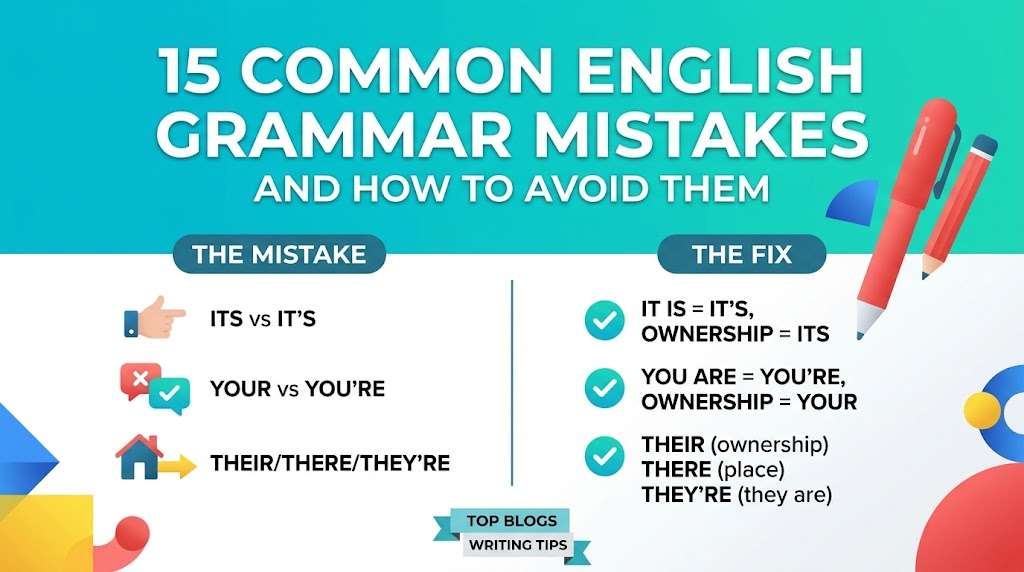
1. Their vs. There vs. They’re
This triad remains one of the most common errors in written English, appearing in business memos and social feeds alike.
-
Their is a possessive pronoun indicating ownership (their project).
-
There refers to a place, physical location, or logical position (over there or there is a problem).
-
They’re is a contraction of the phrase “they are.”
Incorrect: Their going to review there quarterly numbers over they're.
Correct:   They’re going to review their quarterly numbers over there.
Pro Tip: If you can substitute “they are” into the sentence and it still makes structural sense, use They’re. If you can replace it with “our,” use Their.
2. Your vs. You’re
Confusing possession with a state of being can change the entire meaning of your sentence.
-
Your shows possession (your proposal).
-
You’re is the contraction for “you are.”
Incorrect: Your going to love the results of you're campaign.
Correct:   You’re going to love the results of your campaign.
3. Its vs. It’s
Unlike most possessive nouns that require an apostrophe (the manager’s desk), possessive pronouns in English never use apostrophes.
-
Its is a possessive pronoun (the company updated its policy).
-
It’s is strictly a contraction for “it is” or “it has.”
Incorrect: The team completed it's roadmap ahead of schedule.
Correct:   The team completed its roadmap ahead of schedule.
Section 2: Punctuation & Structural Pitfalls
Punctuation marks act as traffic signals for readers, controlling the rhythm, pauses, and relationships between ideas. Improper punctuation creates fractured sentences and confusing logic.
4. The Comma Splice
A comma splice occurs when two independent clauses (complete thoughts that could each stand alone as full sentences) are joined together with only a comma.
Incorrect: We finished the report early, we decided to celebrate.
To fix a comma splice, you have four clear options:
-
Add a coordinating conjunction (and, but, or, so, for, nor, yet) after the comma.
-
Replace the comma with a period to create two distinct sentences.
-
Use a semicolon if the two thoughts are closely linked.
-
Convert one clause into a dependent clause using a subordinating conjunction (such as because, since, or although).
Correct Option 1: We finished the report early, so we decided to celebrate.
Correct Option 2: We finished the report early. We decided to celebrate.
Correct Option 3: We finished the report early; we decided to celebrate.
5. Dangling and Misplaced Modifiers
A modifier is a word, phrase, or clause that describes another element in the sentence. A modifier “dangles” when the target noun it is meant to describe is omitted entirely, or it is “misplaced” when positioned too far from its target noun.
Incorrect: Walking into the office, the summary report was immediately noticed.
Why it fails: As written, this sentence states that the summary report was walking into the office.
Correct: Walking into the office, Sarah immediately noticed the summary report.
Framework for Modifiers: Always place descriptive introductory phrases right next to the person or thing performing the action. Ask yourself: “Who or what is performing the action described in the phrase?”
6. Apostrophe Misuse with Plurals (The “Greengrocer’s Apostrophe”)
A common error is using an apostrophe to form standard plural nouns. Apostrophes indicate possession or contractions—never simple plural forms.
Incorrect: We analyzed the KPI's across all four marketing strategy's.
Correct:   We analyzed the KPIs across all four marketing strategies.
Section 3: Subject-Verb & Agreement Issues
A sentence must maintain structural equilibrium. Singular subjects require singular verbs; plural subjects require plural verbs. Complex phrasing, prepositional phrases, and collective nouns often obscure this basic rule.
7. Subject-Verb Disagreement with Intervening Phrases
Errors frequently happen when words come between the main subject and the verb.
Incorrect: The list of items, including all new reports and documents, are on the desk.
Why it fails: The subject of the sentence is “list” (singular), not “items”, “reports”, or “documents” (plural).
Correct: The list of items, including all new reports and documents, is on the desk.
8. Compound Subjects Joined by “Or” or “Nor”
When two subjects are connected using and, use a plural verb. However, when subjects are linked by or, either/or, or neither/nor, the verb must agree with the subject closest to it.
Incorrect: Neither the manager nor the employees was aware of the change.
Correct:   Neither the manager nor the employees were aware of the change.
If the order is flipped, the verb changes to match:
Correct: Neither the employees nor the manager was aware of the change.
9. Pronoun-Antecedent Disagreement
A pronoun must agree in both number and gender with its antecedent (the noun it replaces).
Incorrect: Every client must submit their paperwork before Friday.
Note on modern usage: While the singular “their” is widely accepted in informal prose and style guides for gender-neutral contexts, formal or academic contexts often prefer precision.
Formal Option 1: All clients must submit their paperwork before Friday. (Plural subject)
Formal Option 2: Every client must submit his or her paperwork before Friday.
Section 4: Word Choice, Usage & Diction Errors
Using the wrong word can alter the technical meaning of a statement, creating confusion in business or academic environments.
10. Affect vs. Effect
-
Affect is almost always a verb meaning to influence or produce a change in something.
-
Effect is usually a noun referring to the result or outcome of an action.
Incorrect: The new marketing strategy had a positive affect on sales.
Correct:   The new marketing strategy had a positive effect on sales.

Incorrect: The weather will effect our delivery schedules.
Correct:   The weather will affect our delivery schedules.
Memory Hack: Remember RAVEN: Remember Affect = Verb, Effect = Noun.
11. Less vs. Fewer
-
Fewer is used for discrete, countable individual items (fewer emails, fewer dollars, fewer people).
-
Less is used for continuous quantities, bulk concepts, or abstract ideas that cannot be individually counted (less time, less money, less water).
Incorrect: We received less job applications this month than last month.
Correct:   We received fewer job applications this month than last month.
12. Lay vs. Lie
-
Lie means to recline or rest oneself (intransitive verb—it does not take a direct object).
-
Lay means to place or put an object down (transitive verb—it requires a direct object).
| Present Tense | Past Tense | Past Participle | Action Required |
| Lie (recline) | Lay | Lain | No direct object |
| Lay (place something) | Laid | Laid | Requires a direct object |
Incorrect: Please lie the documents flat on the conference table.
Correct:   Please lay the documents flat on the conference table.

Incorrect: I am going to lay down for a short afternoon nap.
Correct:   I am going to lie down for a short afternoon nap.
Section 5: Advanced Syntax & Style Errors
Even writers with strong foundations can fall into subtle syntax traps that weaken their writing style.
13. Faulty Parallelism
Parallel structure means using the same grammatical pattern for two or more related items in a list or series. Combining different structures creates awkward, unbalanced sentences.
Incorrect: Our objectives are increasing sales, to improve retention, and customer support optimization.
Why it fails: This mixes a gerund (increasing), an infinitive (to improve), and a noun phrase (customer support optimization).
Correct: Our objectives are increasing sales, improving retention, and optimizing customer support.
14. Passive Voice Overuse
Passive voice occurs when the target of an action is placed as the subject of the sentence, rather than the performer (“The report was written by Jane” instead of “Jane wrote the report”).
While passive voice is acceptable when the actor is unknown or irrelevant, overusing it leads to wordy, indirect writing.
Weak (Passive):   A new product line was launched by our team last week.
Strong (Active):  Our team launched a new product line last week.
15. Misplaced Adverbs (Especially “Only”)
The word only is extremely flexible in English, but placing it in the wrong position changes the meaning of your entire sentence.
Consider how the placement of only shifts the narrative:
-
Only John called the client yesterday. (Nobody else called the client.)
-
John only called the client yesterday. (John did nothing else—he didn’t email or visit.)
-
John called the only client yesterday. (There was just one client to call.)
-
John called the client only yesterday. (It happened as recently as yesterday.)
Rule: Place adverbs like only, nearly, and almost directly before the specific word or phrase they modify.
Quick Reference Summary
| Error Type | What to Watch For | Quick Fix Strategy |
| Homophones | Sound-alike words (they’re / their) | Use substitution checks (they are vs. our) |
| Punctuation | Comma splices & misplaced apostrophes | Join independent clauses with conjunctions or semicolons |
| Agreement | Subject-verb mismatch over long phrases | Identify the true simple subject of the sentence |
| Diction | Affect/Effect, Less/Fewer | Apply countability and part-of-speech checks |
| Structure | Parallelism & misplaced modifiers | Keep lists grammatically symmetrical |
Frequently Asked Questions (FAQ)
What is the most common grammar mistake in business writing?
The most common grammar errors in professional settings involve homophone misuses (such as it’s/its and your/you’re) and comma splices. These mistakes often occur when writers type quickly without performing a deliberate proofreading pass.
How can I train myself to catch grammar errors before publishing?
Read your text out loud or use text-to-speech software. When reading silently, your brain automatically fills in missing words and corrects mistakes based on intended meaning. Hearing the text forces you to process each word individually.
Is it ever acceptable to end a sentence with a preposition?
Yes. Modern English style guides agree that ending a sentence with a preposition (“Where are you coming from?”) is acceptable when rearranging the sentence creates stiff or awkward phrasing (“From where are you coming?”).

Nasir is our resident expert with 5 years of experience in business development and marketing strategies. With a keen eye for market trends and a knack for creating impactful campaigns, Nasir helps drive our vision forward with innovative solutions and data-driven insights. His articles provide valuable perspectives on navigating the ever-evolving world of business.