
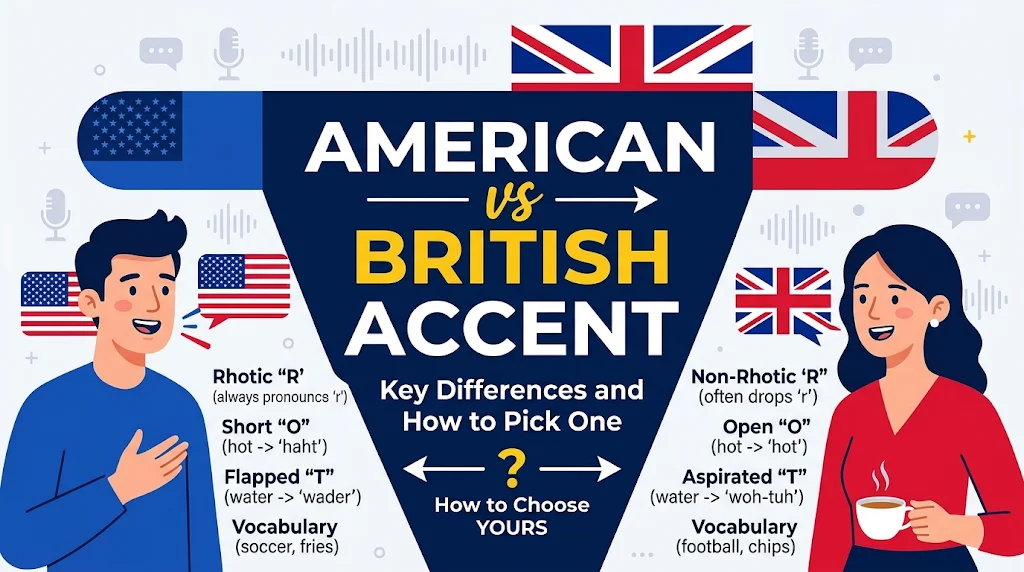
When learning English, one of the first major decisions you will face is deciding which accent to cultivate. Should you speak with the crisp, melodic cadence of British English or the smooth, retroflex resonance of General American?
This choice goes far beyond simple pronunciation. Your accent shapes how others perceive your clarity, influences your cultural integration, and affects your confidence when speaking in professional or academic environments.
Many learners fall into the trap of mixing both accents, resulting in an inconsistent phonetic profile that can confuse listeners. Others spend months trying to master one without realizing it doesn’t align with their career goals or regional lifestyle.
This guide breaks down the core phonetic, structural, and lexical differences between General American (GenAm) and British Received Pronunciation (RP) / Standard Southern British (SSB). You will also learn a practical, step-by-step framework to help you choose the accent that best fits your personal and professional path.
The Root of the Split: How American and British Accents Diverged
A common misconception among English learners is that American English diverged from a historic “pure” British accent. Historical linguistics reveals a different reality: early American settlers brought 17th-century regional British dialects across the Atlantic.
At that time, speech across the UK was largely rhotic—meaning the “r” sound was pronounced after vowels in words like card and water. During the Industrial Revolution, standard British speech evolved toward non-rhoticity in Southern England to distinguish social classes, giving rise to Received Pronunciation. Meanwhile, American speech retained many of these historic rhotic elements.
Understanding this linguistic split explains why neither accent is inherently more authentic. They are simply sibling dialects that diverged along distinct historical paths.
Key Takeaway: American English is not a modified version of modern British English. In fact, General American retains several phonetic features—such as full rhoticity—that were common in 17th-century Britain.
4 Core Phonetic Differences Between American and British Accents
Mastering an accent requires training your vocal tract, tongue placement, and airflow to execute specific phonetic rules consistently. Below are the primary technical distinctions between General American and Standard British English.
+---------------------+-------------------------------+--------------------------------+
| Phonetic Feature    | General American (GenAm)      | British Standard (RP / SSB)    |
+---------------------+-------------------------------+--------------------------------+
| Rhoticity           | Rhotic (Pronounces post-vowel | Non-Rhotic (Drops 'r' unless   |
|                     | /r/)                          | followed by a vowel)           |
+---------------------+-------------------------------+--------------------------------+
| The "TRAP-BATH"     | Uses /æ/ (flat 'a') for both  | Uses /æ/ for TRAP, /ɑː/ (broad |
| Split               | TRAP and BATH words           | 'a') for BATH                  |
+---------------------+-------------------------------+--------------------------------+
| Flap T vs. True T   | Intervocalic /t/ becomes a    | Intervocalic /t/ remains a     |
|                     | voiced flap /ɾ/ ("water" ->   | crisp, voiceless /t/ or glottal|
|                     | "wah-der")                    | stop                           |
+---------------------+-------------------------------+--------------------------------+
| Yod-Dropping        | Drops /j/ after alveolar      | Retains /j/ glide ("tune" ->   |
|                     | consonants ("tune" -> "toon") | "tyoon")                       |
+---------------------+-------------------------------+--------------------------------+
1. Rhoticity: The Power of the Post-Vowel “R”
The most prominent phonetic divider between American and British speech is rhoticity.
-
General American (Rhotic): Every written “r” is pronounced, regardless of its position in a word. The tip of the tongue curls upward or bunches back to produce the retroflex or bunched /ɹ/ sound.
-
Examples: Car (/kɑɹ/), Hard (/hɑɹd/), Water (/ˈwɑː.t̬ɚ/).
-
-
British RP / SSB (Non-Rhotic): The “r” sound is pronounced only if it is immediately followed by a vowel sound. If the “r” comes at the end of a word or before a consonant, it is silent, lengthening the preceding vowel into a schwa /ə/ or long monophthong.
-
Examples: Car (/kɑː/), Hard (/hɑːd/), Water (/ˈwɔː.tə/).
-
Pro Tip: Look for the “Linking R” in British English. While British speech is non-rhotic, if a word ending in “r” is followed immediately by a word starting with a vowel, the “r” reappears. For example, “Far away” is pronounced as /fɑː rəˈweɪ/.
2. The TRAP-BATH Split: Short “a” vs. Broad “a”
In General American, words containing the letter “a” in short stress positions maintain a consistent, flat /æ/ sound—the same sound found in cat or trap.
In British English, words split into two distinct categories:
-
TRAP Class: Uses the short /æ/ sound (cat, map, hand, trap).
-
BATH Class: Shifts to a deep, back-of-the-throat broad /ɑː/ sound when the “a” precedes sounds like /s/, /f/, /θ/, or /n/ followed by another consonant.
-
American: Dance (/dæns/), Path (/pæθ/), Ask (/æsk/), Half (/hæf/).
-
British: Dance (/dɑːns/), Path (/pɑːθ/), Ask (/ɑːsk/), Half (/hɑːf/).
3. Intervocalic T: The Flap “T” vs. The True “T”
How a speaker treats the letter “t” when it sits between two vowels (intervocalic position) immediately signals their accent origin.
-
General American Flap T (/ɾ/): When an unaccented “t” or “tt” appears between vowels, Americans tap their tongue against the alveolar ridge, creating a brief, voiced sound close to a light /d/.
-
Butter sounds like “bud-der”.
-
City sounds like “sid-ee”.
-
Better sounds like “bed-der”.
-
-
British True T (/t/) or Glottal Stop (/ʔ/): Standard British keeps the crisp, voiceless release of the tongue against the teeth ridge. In modern urban speech, this is often replaced with a glottal stop—stopping airflow at the vocal folds without using the tongue tip.
-
Butter sounds like “but-tuh” (crisp release) or “bu’-uh” (glottal stop).
-
4. Yod-Dropping: “Toon” vs. “Tyoon”
The phoneme /j/ (the “y” sound in yes) is treated differently after alveolar consonants (/t/, /d/, /n/, /s/, /z/, /l/).
-
General American (Yod-Dropping): Americans drop the /j/ sound after alveolar consonants.
-
Tune -> /tuːn/ (sounds like “toon”).
-
Duty -> /ˈduː.ti/ (sounds like “doo-tee”).
-
New -> /nuː/ (sounds like “noo”).
-
-
British Standard (Yod-Retention): British speakers preserve the glide.
-
Tune -> /tjuːn/ (sounds like “tyoon”).
-
Duty -> /ˈdjuː.ti/ (sounds like “dyoo-tee”).
-
New -> /njuː/ (sounds like “nyoo”).
-
Vocabulary, Spelling, and Stress Distinctions
Phonetics is only part of the equation. To speak an accent naturally, you also need to align your vocabulary, spelling, and stress patterns.
Everyday Vocabulary Differences
Using an American accent with British terms (or vice versa) can sound unnatural to native ears. Here are key Everyday terminology differences:
| Item / Concept | General American | British English |
| Car Storage Space | Trunk | Boot |
| Footwear | Sneakers | Trainers |
| Long-term Vacation | Vacation | Holiday |
| Apartment Building | Apartment | Flat |
| Urban Footpath | Sidewalk | Pavement |
| French Fried Potatoes | Fries | Chips |
| Potato Snack | Chips | Crisps |
| Queue of People | Line | Queue |
Word Stress Shift Patterns
Certain French-derived loanwords shift stress depending on the regional standard:
-
American English tends to stress the final syllable:
-
Café (/kæˈfeɪ/)
-
Garage (/ɡəˈrɑːʒ/)
-
Ballet (/bæˈleɪ/)
-
-
British English typically stresses the first syllable:
-
Café (/ˈkæf.eɪ/)
-
Garage (/ˈɡær.ɑːʒ/)
-
Ballet (/ˈbæl.eɪ/)
-
4-Step Decision Framework: How to Pick Your Accent
+---------------------------------------------------------------------------------+
|                       ACCENT SELECTION DECISION MATRIX                          |
+---------------------------------------------------------------------------------+
|                                                                                 |
|  STEP 1: GEOGRAPHIC & CAREER TARGETING                                          |
|  ├── North America / Tech / Hollywood / Global Business ──> General American     |
|  └── UK / Europe / Commonwealth / Academia / Theatre    ──> British (RP / SSB)  |
|                                                                                 |
|  STEP 2: ANATOMICAL & PHONETIC COMFORT                                          |
|  ├── Mother tongue has strong /r/ or flat vowels          ──> General American     |
|  └── Mother tongue has non-rhotic patterns / crisp /t/   ──> British (RP / SSB)  |
|                                                                                 |
|  STEP 3: CONSUMPTION ENVIRONMENT                                                |
|  ├── Media diet: US Shows, Podcasts, YouTube             ──> General American     |
|  └── Media diet: BBC, British Dramas, Audiobooks         ──> British (RP / SSB)  |
|                                                                                 |
|  STEP 4: INTENTION & GOAL DEFINITION                                            |
|  ├── High clarity across international teams             ──> Neutral American    |
|  └── Classic elegance in formal European settings        ──> Standard British    |
+---------------------------------------------------------------------------------+
Choosing between an American or British accent should be a strategic decision based on your goals, environment, and physical speech tendencies.
Step 1: Map Your Geographic and Professional Target
Where do you plan to work, study, or live?
-
Choose General American if: You work in tech, entertainment, international startups, or corporate business environments focused on North America, Latin America, or East Asia. American media exposure makes GenAm widely understood in international commerce.
-
Choose British Standard if: You target higher education in the UK or Europe, work within Commonwealth countries (such as Australia, New Zealand, or South Africa), or operate in traditional international institutions like European diplomacy or classical theatre.
Step 2: Audit Your Native Language’s Phonetics
Your native language provides physical muscle memory for speech. Matching your native mechanics to a target accent reduces learning friction.
-
Native Rhotic Languages: If your mother tongue already features a strong retroflex or rolled “r” (such as Spanish, Russian, or Persian), leaning into the rhoticity of General American often feels more natural.
-
Non-Rhotic or Crisp-T Languages: If your native language lacks a heavy post-vowel “r” or uses sharp dental consonants (such as French, Italian, or Japanese), the non-rhotic flow and precise articulation of British English may take less effort to adapt.
Step 3: Evaluate Your Media Consumption Habits
Accent acquisition relies heavily on passive listening. You will naturally acquire the accent you hear most often.
Ask yourself:
-
Do you binge-watch American shows, consume US podcasts, and follow American content creators?
-
Or do you regularly listen to BBC broadcasts, watch British period dramas, and enjoy UK audiobooks?
Select the accent that matches your daily media intake to maximize natural reinforcement.
Step 4: Commit Fully to One Accent Profile
The biggest mistake learners make is picking elements from both accents haphazardly. Blending a heavy American Flap-T with British non-rhoticity (“bud-duh” instead of “butter”) can sound disjointed to native ears.
Pick one profile, set your dictionary preferences to match (e.g., Merriam-Webster for GenAm, Oxford for RP), and focus on consistency.
Common Accent Mistakes to Avoid
Even dedicated language learners frequently encounter friction when building their target accent. Here are four common pitfalls and how to fix them.
Pitfall 1: Over-Rhoticizing in British English
-
The Error: Forcing an “r” sound at the end of every word when attempting a British accent because it appears in the spelling.
-
The Fix: Train your ear to treat terminal “r” letters as simple vowel extenders. Practice dropping the tongue down toward the floor of your mouth whenever an “r” follows a vowel sound, letting the sound resolve into a relaxed schwa (/ə/).
Pitfall 2: The “Over-Flapped T” in American English
-
The Error: Turning every single “t” sound into a “d” sound in General American, even at the beginning of words or stressed syllables.
-
The Fix: Remember that the Flap T only occurs when the “t” sits between two vowels and the following syllable is unstressed.
-
Correct: Water (/ˈwɑː.t̬ɚ/) uses a Flap T.
-
Incorrect: Attack (/əˈtæk/) uses a sharp, aspirating True T because the second syllable carries primary stress.
-
Pitfall 3: Mixing Regional Vocabularies
-
The Error: Using American terms while applying British pronunciation rules (e.g., pronouncing chips with a deep British broad-A while referring to American french fries).
-
The Fix: Build a targeted vocabulary list that aligns with your chosen accent profile. If you adopt British pronunciation, adopt British lexical choices (flat, lift, boot, queue) consistently.
Pitfall 4: Obsessing Over Accent Elimination Instead of Clarity
-
The Error: Focusing so intensely on mimicking native accent nuances that your overall fluency, pacing, and clarity suffer.
-
The Fix: Prioritize international intelligibility first. Clear articulation, accurate stress patterns, and steady pacing matter more than perfectly imitating a native regional accent.
Frequently Asked Questions
Is an American accent easier to learn than a British accent?
For most global learners, General American is often perceived as easier to learn due to its heavy presence in global media, movies, music, and software. However, learners whose native languages lack a strong “r” sound may find the non-rhotic patterns of British English easier to articulate physically.
Which accent is better for international business?
Neither accent is objectively superior for business. General American is widely used in multinational corporate environments, tech industries, and global marketing. British English remains highly respected across European markets, academic institutions, and international legal fields. Focus on clarity, confidence, and consistency over regional preference.
Will mixing American and British accents cause communication problems?
While occasional mixing will not prevent basic understanding, blending phonetics systematically—such as combining American rhoticity with British broad vowels—can sound unnatural to native listeners. Sticking to a single accent profile makes your speech sound more natural and cohesive.
What is Received Pronunciation (RP)?
Received Pronunciation (RP), often called “the Queen’s English” or “BBC English,” is the traditional standard accent of Southern England. While historically associated with high social standing and formal broadcasting, modern British speech has evolved into a more relaxed variant known as Standard Southern British (SSB).
Master Your Chosen Accent
Choosing between an American and British accent comes down to aligning your speech patterns with your personal goals, target geography, and daily listening habits.
Neither choice is inherently better—what matters most is committing to one system, practicing its phonetic rules, and speaking with clarity and confidence.

Nasir is our resident expert with 5 years of experience in business development and marketing strategies. With a keen eye for market trends and a knack for creating impactful campaigns, Nasir helps drive our vision forward with innovative solutions and data-driven insights. His articles provide valuable perspectives on navigating the ever-evolving world of business.